Thursday, October 18, 2012

The Adventures of Batty and Black: College Edition

Sometimes I like to doodle. I am not an artist. There are about three things I can draw: hippos, rocket ships, and hippos in rocket ships. Sometimes I can draw dinosaurs, but it has to be a good day to get a good dinosaur.

My siblings and I used to draw these little creatures called "chao" (said like "chow") from a Sonic game. Lately I've been doodling them. I don't really know why. Maybe because they take very little skill to draw, at least in the style I draw them.

(Yes, I have been paying attention in class.)

This is a chao. (Sorry, I know the pictures aren't great.)


And this is Batty. He's the main character of the chao comic strips I used to draw.


Batty was a weird little guy. He liked to eat words.


And do random things like go parachuting.


Unfortunately, it didn't always work out so well for him.


But he always made it out okay in the end.


He liked to sleep a lot.


And eat chao fruit.


He lived in a hole in the ground...


...with his brother, Black.


They also had a little sister named Sunsun.


Batty and Black would race the other chao while riding on a fridge with wheels.


But they were usually beaten by Pickles and Joy, who rode on a star.
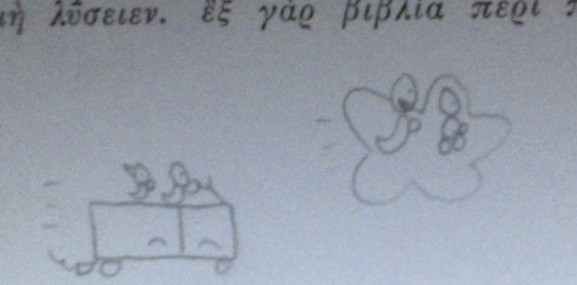

And their friends Ghostly and Gray beat all of them, except I can't remember what they rode.


Someone remind me to go over my Greek textbook with a heavy duty eraser if I sell it when I'm done with this course.


Monday, October 15, 2012

Combing, Foraging, Scouring

I used to like the word "searching." It's not a bad word. It makes me think of a medieval type fairy tale or something. You know, the intrepid adventurers set out on their valiant quest to seek out the lost princess/evil dragon/legendary treasure/wish-granting fountain/magical herb/etc etc. The search high and low until they find their goal, and then they come back home to glory, honor, feasting, and a happily ever after. The end.

The problem comes in when somewhere between steps two and three, they run into some difficulties, and they discover they're doing a whole lot of searching and a whole lot less finding. Because searching gets old after a while if they're not finding anything. Then they just want to give up, forget about finding the lost princess/evil dragon/legendary treasure/wish-granting fountain/magical herb/etc etc, and go home and sleep. However, they do not become famous and get glory, honor, feasting, and a happily ever after, because no one wants to read a fairy tale about the guy who gave up and went back to bed.

This is why I don't see my phone being made into a fairy tale any time soon. Or my Wi-Fi connection.

...or me, judging by my ability to lose the same pencil three times in one study session. And it was in the same place all three times.

Sigh.

Tuesday, October 9, 2012

Topsy-Turvy

Tuesdays are weird. Well, not always. Sometimes my friends and I use them to be silly (like when people ask us things – "Do you like ______?" "Only on Tuesdays."). But some Tuesdays are just weird in themselves.

Take today, for example. I had Greek. That was normal. I was tired. That was also, unfortunately, somewhat normal. Then I went to CMS (Congregational and Ministry Studies). That was normal. Except we got out early. That was not normal. This meant I actually had time for lunch before Religion at 12:05. That was also not normal. So I texted my friend who's in Religion with me to see if she wanted to have lunch together before class. She replied that Religion was cancelled. So I checked my email, and sure enough, no Religion class today.

Suddenly I have no class until Prelude at 6:30. This is very bizarre. I am used to Tuesday being a busy day.

Not to complain about it, though – more time to study for my CMS midterm on Thursday. And that's definitely a good thing.

But for now, anyway, I'm off to lunch.

Thursday, October 4, 2012

Ancient Greek Is Actually Applicable To My Life

Well, maybe.

Greek 101 is always a bit of an adventure. It's a bit overwhelming at times – new alphabet, new language, new rules that come with new alphabet and new language – and sometimes it's just kind of crazy. Plus there's lots of vocab to remember, and I have to know all the accents and different forms and the gender of the words. Crazy.

Studying Greek vocab can actually be pretty interesting, though – like with studying Latin vocab, there are a lot of English words that come from the Greek. The more obvious ones are helpful (like δημοκρατίᾱ, δημοκρατίᾱς, ἡ – or demokratia, demokratias to use a more familiar alphabet. It means democracy). The less obvious ones expand my English vocabulary (to go with a Latin example, melior, melius means better. We get the English word ameliorate from it).

And then there are the ones that jump out because they're just awesome little discoveries. In this case, I was reading my vocab aloud and I came across εἰρήνη, εἰρήνης, ἡ – eirene, eirenes to roughly transliterate it. Spoken, it sounds kind of like erin-ay, and it means peace.

I did a little research online and found that most sites that have the etymology of the name Erin attribute it to the Irish (its possible meanings are peacemaker and Ireland). I also discovered a bit about Erin/Éire/Ériu, a goddess from Irish mythology – legend has it she and her sisters Fodla and Banba represented love, peace, and hope or joy. Éire was believed to be the goddess of peace as well as the patron goddess of Ireland. As I learned in class, the name Irene for sure comes from the Greek word.

I don't know if the Irish word actually comes from the Greek, but they sound alike and have the same meaning, and that's good enough for me.

Monday, October 1, 2012

Unshod (Feet for the Path)

Here are the sounds of Wear. It rattles stone on stone. It sucks its teeth. It sings. It hisses like the rain. It roars. It laughs. It claps its hands. Sometimes I think it prays. In winter, through the ice, I've seen it moving swift and black as Tune, without a sound. 
Here are the sights of Wear. It falls in braids. It parts at rocks and tumbles round them white as down or flashes over them in silver quilts. It tosses fallen trees like bits of straw yet spins a single leaf as gentle as a maid. Sometimes it coils for rest in darkling pools and sometimes leaps its banks and shatters in the air. In autumn I've seen it breathe a mist so think and grey you'd never know old Wear was there at all. 
Each day, for years and years, I've gone and sat in it. Usually at dusk I clamber down and slowly sink myself to where it laps against my breast. Is it too much to say, in winter, that I die? Something of me dies at least. 
First there's the fiery sting of cold that almost stops my breath, the aching torment in my limbs. I think I may go mad, my wits so outraged that they seek to flee my skull like rats a ship that's going down. I puff. I gasp. Then inch by inch a blessed numbness comes. I have no legs, no arms. My very heart grows still. The ancient flesh I wear is rags for all I feel of it. 
"Praise, praise!" I croak. Praise God for all that's holy, cold, and dark. Praise him for all we lose, for all the river of the years bears off. Praise him for stillness in the wake of pain. Praise him for emptiness. And as you race to spill into the sea, praise him yourself, old Wear. Praise him for dying and the peace of death.
from Godric by Frederick Buechner 
I have a friend who has found that wearing shoes in college is an optional activity. More often than not I see her going shoeless about campus. My friend was barefoot again in our religion class on Thursday, where we read God's Grandeur by Gerard Manley Hopkins. We also read that poem when I was in AP English last year – at least, I think it was AP English, because I could hear Mr. H's voice when our prof was reading it – and that, together with my friend's running about unshod, reminded me of Godric.

Godric was an AP English book, a fictional account of the life of St. Godric of Finchale. Buechner writes in medieval Anglo-Saxon style, which can be a little hard to understand, especially at first. At the same time, it makes the book even more amazing that it already is. There's a reason my copy of it came to college with me.

The passage above is one we spent some time on in class. Our teacher handed out sheets of paper with that passage divided into lines, and we each took one here and one there and read them. We stood in a circle in our classroom and read them. We spread ourselves out in the darkened auditorium and read them. We stood on the concrete around the landscape in front of school and read them. We roamed about the lawn – unshod – and read them.

As Hopkins's poem implies, there's something unique about walking around unshod. He references it as a connection to the earth – or a lack of it, as the feet in his poem are all shod. In AP English, we found a bit of fun in walking about unshod, and a bit of grace.

Godric, too, walked about unshod – in fact, he spent the last sixty or so years of his life that way. In fact, one of the chapters of Buechner's book is titled after Godric's feet.
"Poor feet," I said, "I've used you ill for Jesu's sake. I've tramped with you a thousand miles and more without a scrap of hide to ease your way. I've brought you to this place. I've cut all lines adrift that moored me to the life I knew. I've set myself adrift. So lead me now, old feet. Take me the way that I must go for Jesu's sake. Godric, who's been merciless to you, casts him upon your mercy now."
RVL would often pray in Discipleship not for a smooth road, but for feet for the path. Sometimes I wonder if those feet might be intended to go unshod every now and then.